

Private Jet or Commercial Flight: Which Offers the Best Value, Convenience and Luxury?
Choosing between a private jet and a scheduled airline is a question of priorities: price, time and the level of control or comfort your trip requires. This guide defines private jet charter, contrasts it with commercial travel and explains when each option is the better fit for business trips, urgent freight or high‑end leisure travel. You’ll find the main cost drivers, where private travel saves time, how cabins differ and why privacy and security matter. The focus is UK and Europe, with quantified door‑to‑door components and practical examples — from executive, multi‑stop schedules to urgent cargo missions — so you can judge which approach best meets your objectives.
How Do Private Jet and Commercial Flight Costs Compare?
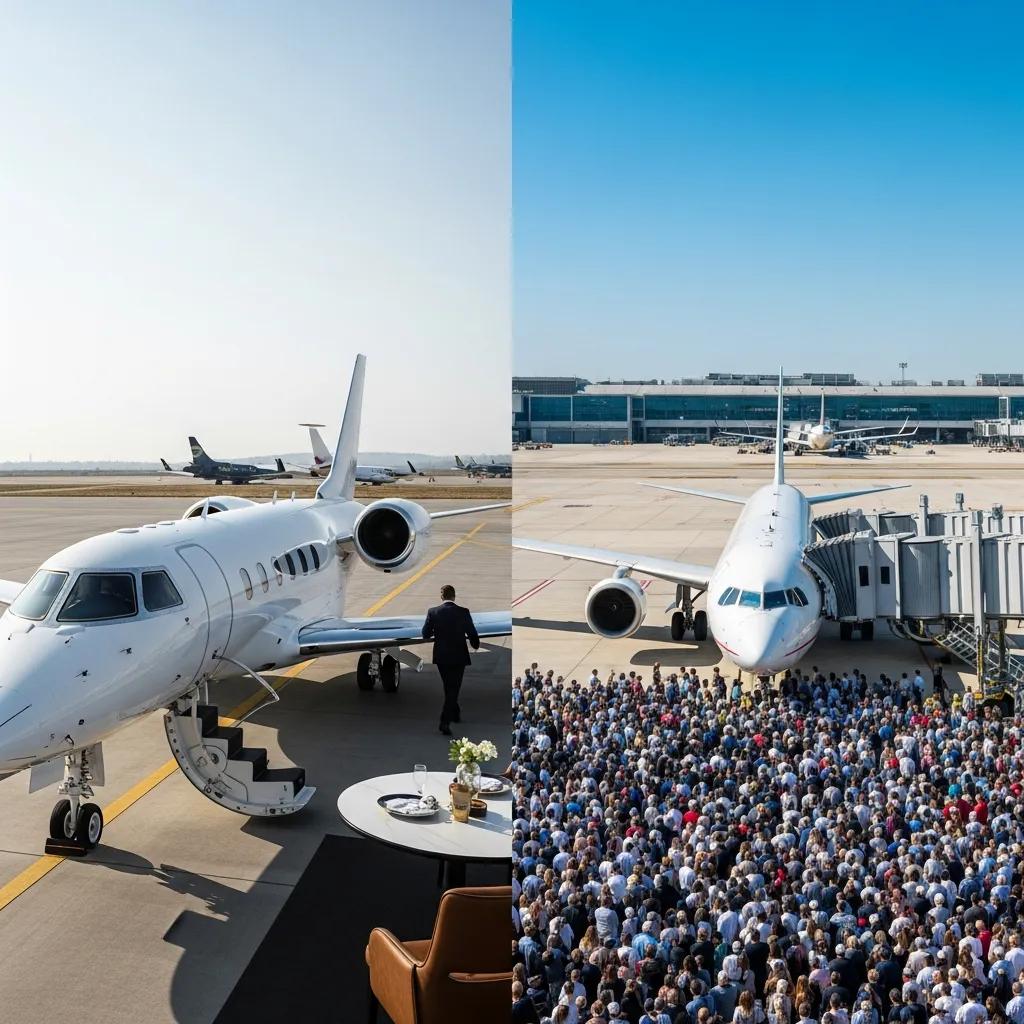
Private charter is priced primarily on usage — aircraft hours, repositioning and handling — while airline tickets are sold per seat and driven by published fares and market demand. Charters charge for flight time, repositioning (empty legs) and ground costs, so aircraft class and itinerary directly affect the total. Airline fares are per passenger but can hide time and ancillary costs. Consequently, private flying usually carries a higher hourly rate but can be more cost‑effective for multi‑stop trips, urgent freight or missions where time is the overriding factor. Understanding the principal cost drivers lets you compare net costs by route and passenger count.
Key private charter cost drivers include hourly aircraft rates, positioning legs, landing and handling fees, crew overtime and overnight costs, and seasonal surcharges. Commercial cost drivers include base fare, baggage and seat fees, surface transfers and the indirect cost of lost productivity from longer journeys.
- Hourly aircraft rates increase with aircraft class and mission length.
- Positioning or empty‑leg flights add fixed costs when the aircraft operates without revenue passengers.
- Airport handling and peak‑season demand create surcharges for both charter and scheduled services.
The table below summarises typical drivers by option and aircraft class so you can see where price differences arise.
Aircraft class and mission profile strongly determine private charter pricing, while airline fares stay per‑seat and often add non‑ticket costs. After reviewing these drivers, many clients request bespoke quotes that reflect passenger numbers and itinerary complexity. Specialist operators with 24/7 booking can provide transparent, mission‑specific estimates and help you compare net costs for your route.
What Factors Influence Private Jet Charter Pricing in the UK?
UK private charter pricing depends on aircraft type, block hours and operational requirements tied to the route and airfield. Core inputs are the aircraft category (light, midsize, heavy), flight hours and any repositioning required — each raises the operator’s cost base. Additional variables include landing fees, FBO handling charges, slot availability and seasonal demand; crew duty rules and overnight accommodation add costs on multi‑day missions. These elements explain why quotes differ between routes and operators.
Operators also factor regulatory compliance: flights under CAA or EASA‑approved AOCs follow robust safety and operational standards that feed into pricing. Busy events and airports in the UK can increase landing and parking fees, while empty‑leg opportunities may reduce repositioning costs when schedules align. Passenger count is important, because per‑person economics improve when costs are shared across several travellers.
What Hidden Costs Should You Consider with Commercial Flights?
Low headline fares on scheduled airlines often conceal ancillary or indirect costs that matter for time‑sensitive travellers. Fees for checked bags, seat selection, priority boarding and onboard purchases add up, while long transfers from hubs, minimum connection times and overnight stays for inconvenient connections increase total trip expense. For business customers, lost productive time during lengthy journeys is a measurable cost that private charters can reduce.
Other overlooked items include airport parking, taxi or ride‑share fares, the risk and cost of missed connections, and limited flexibility to change plans quickly. When comparing options, add these ancillaries to the ticket price and convert time lost into monetary value to produce a genuine apples‑to‑apples comparison. That approach often explains why a private charter can be the more efficient choice for certain missions despite a higher headline rate.
How Does Travel Time Differ Between Private Jets and Commercial Flights?
Time savings come from boarding, routing and airport access: private jets shorten door‑to‑door journeys through expedited FBO processing, direct routings and access to nearer airfields, while airlines rely on hub schedules, longer security queues and fixed connection windows. Fewer touchpoints and greater routing flexibility reduce total journey time — a tangible benefit for travellers who value time. Quantifying door‑to‑door elements clarifies the typical time advantages for both business and leisure travel.
A practical door‑to‑door breakdown shows where private travel saves minutes: faster FBO check‑in, minimal boarding time, reduced taxiing and direct routings that remove connections. Commercial travel usually requires earlier arrival, longer security queues and acceptance of hub detours that add hours to the journey.
Minutes on scheduled services quickly become hours — private options reclaim that time. Cutting door‑to‑door duration delivers real business value, such as same‑day multi‑city meetings or urgent cargo deliveries, so include time in your cost assessment for mission‑critical planning.
Why Do Private Jets Offer Faster Direct Routes and Boarding?
Private jets benefit from direct routings and streamlined ground handling that reduce en‑route time and airport processing. Avoiding hub detours and, on many segments, operating at favourable cruise levels can shorten flight time; at the airport, FBOs provide private lounges, fast security and direct ramp access so passengers can arrive shortly before departure and spend less time on the ground.
Smaller passenger numbers and straightforward boarding procedures also speed turnarounds, enabling same‑day returns or multiple stops. This operational flexibility suits tight business schedules and last‑minute changes, preserving productive hours that scheduled airlines typically lose.
How Do Airport Access and Ground Times Affect Commercial Flight Duration?
Major airports concentrate operations and generally require earlier arrivals, longer security queues and often lengthy surface transfers — all of which extend total travel time. Hub‑and‑spoke networks are efficient for airlines but impose connection penalties on travellers, including minimum connection times and increased risk of missed flights that cause cascading delays. Road transfers to and from large hubs — frequently outside city centres — add significant surface travel time.
Regional and smaller airports offer quicker surface access, shorter queues and faster turnarounds; however, scheduled airlines may not serve them frequently. If your final destination lies close to a regional airfield, private charter access can eliminate long transfers and cut door‑to‑door time substantially. Evaluating ground‑time elements against itinerary goals shows where private options deliver meaningful savings.
What Are the Comfort and Luxury Differences Between Private Jets and Commercial Flights?
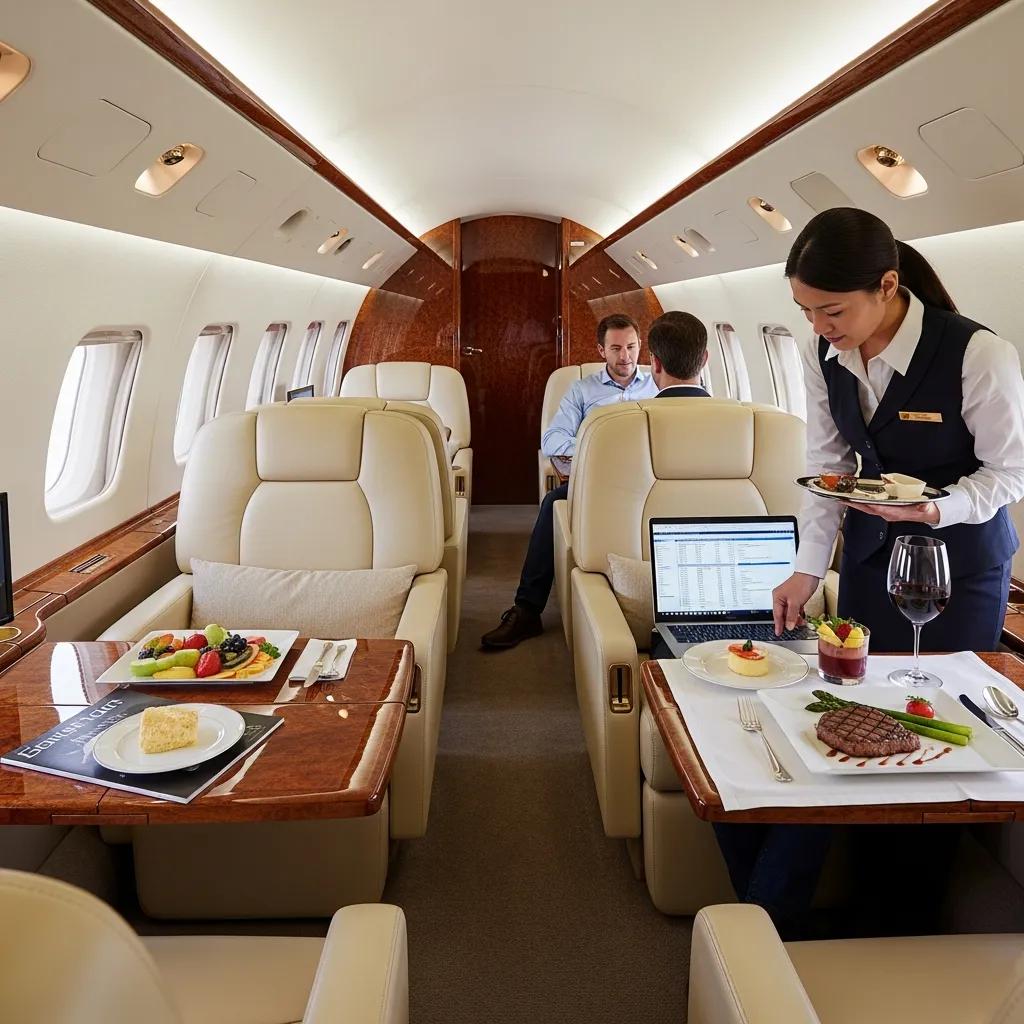
Private jets prioritise personalised comfort: bespoke cabin layouts, configurable seating and tailored onboard service. Airline first and business cabins offer excellent amenities but limited customisation. The private advantage is complete cabin control — you choose seating, catering and privacy levels, and the operator can configure the interior for meetings, rest or family travel. That control supports productivity, privacy and a level of service premium cabins can only partially match.
Private cabins often resemble a comfortable lounge, with dedicated work areas, custom catering and pet‑friendly arrangements that suit both corporate and leisure needs. Airline premium cabins excel in seat quality and professional service but remain constrained by fixed layouts and shared spaces. The list below highlights the main comfort differences to help you prioritise what matters most.
- Cabin customisation: Private jets enable bespoke seating plans and private meeting zones.
- Onboard service: Catering and service timetables are tailored to passenger preference on charters.
- Privacy and pets: Charters accommodate discreet travel and pet provisions that airlines often restrict.
While premium airline cabins can match certain aspects of private travel, private jets remain superior for fully bespoke service and uninterrupted space — a decisive factor for executive missions and high‑value leisure trips.
How Do Private Jet Interiors and Amenities Enhance Your Travel Experience?
Private jet cabins are configured to support comfort, productivity and personalised service: flexible seating, dedicated workspaces and tailored catering to meet passenger needs. The principle is tailored service — crew and caterers follow bespoke menus, Wi‑Fi and cabin setups for meetings or family time, and pet arrangements reduce stress for animals and owners. These features lift productivity for executives and create a more relaxed journey for families or VIPs.
Practical examples include converting the cabin into a meeting space, providing specialist catering for dietary requirements, or installing secure videoconferencing. Operators with varied fleets and experienced, type‑rated crews deliver these setups reliably, ensuring consistent comfort across missions. In short, tailored interiors make travel a working or leisure environment, not just transit.
How Does Commercial First Class Compare to Private Jet Comfort?
Airline first and business class provide premium seats, refined service and greater privacy than economy, but they remain limited by cabin design and fixed service patterns. Airlines offer lie‑flat seats, curated menus and exclusive lounges that enhance comfort, yet passengers still share space and must follow set boarding and disembarkation procedures — restricting personalisation compared with private charters.
Where premium cabins align with private jets is in seat quality and professional service, but they cannot offer a wholly private cabin, bespoke schedules or fully tailored multi‑leg itineraries. If absolute confidentiality, in‑flight meetings or transporting special cargo or animals are priorities, private charter has a clear edge. Weighing these trade‑offs helps determine whether the extra cost of a private cabin is justified for your mission.
Why Is Privacy and Security Better on Private Jets Than Commercial Flights?
Private jets deliver enhanced privacy and bespoke security because they operate from private terminals, control passenger lists and use tailored ground handling to reduce exposure. The mechanism is straightforward: operators manage boarding access, parking location and staff interactions, enabling confidential travel with fewer public touchpoints.
- Private terminal (FBO) boarding keeps passengers out of public departure areas.
- Strict manifest control and passenger vetting limit unplanned contacts.
- Bespoke handling reduces visibility for high‑profile clients and valuable cargo.
Private flight security typically includes passenger vetting, manifest checks and tailored screening consistent with CAA or EASA standards; these practices complement operator oversight and reduce public exposure. The controlled environment supports discreet scheduling and secure handling — key reasons many clients choose charter when confidentiality and security are essential.
How Do Private Jets Provide Discreet and Uninterrupted Travel?
Discretion stems from private terminal access, pre‑planned crew and ground coordination, and restricted passenger lists that avoid unexpected encounters. FBOs offer private lounges and direct ramp access, keeping passengers out of busy terminals; ground staff and crew follow confidentiality procedures to limit disclosures. This approach delivers uninterrupted itineraries with minimal ground‑side interaction, preserving privacy on arrival and departure.
Bespoke scheduling and controlled ground handling also reduce the risk of media or crowd exposure at high‑profile events. For executives needing secure transit between meetings or VIPs attending private gatherings, these measures protect schedules and reputations. Private charter therefore combines convenience and confidentiality in one solution.
What Security Protocols Differentiate Private Jet Travel from Commercial Flights?
Private operators use tailored security protocols — passenger vetting, manifest verification and controlled boarding flows — while operating within CAA or EASA regulatory frameworks. Operator oversight and crew qualifications provide assurance that safety standards are met; direct coordination with FBO security reduces public screening points. These elements demonstrate operational integrity to clients.
By contrast, commercial airlines rely on standard public screening for large passenger volumes. Private operators can adapt procedures to a mission’s risk profile and cargo sensitivity, enabling tightly controlled handling for high‑value items or confidential travel. As a result, private charters offer a differentiated security posture suited to bespoke requirements.
How Does Flexibility and Control Differ Between Private Jet and Commercial Flight Options?
Flexibility and control are core advantages of private charter: on‑demand departures, last‑minute itinerary changes and access to smaller airports widen operational choices and let flights align with business needs. Operational autonomy lets private operators set departure times, routing and airport choice — enabling flights outside published schedules or to airfields not served by scheduled carriers. This capability supports time‑sensitive business missions, urgent cargo and tailored leisure itineraries that scheduled airlines cannot match.
- On‑demand departures: Flights depart when passengers need them, not when a timetable dictates.
- Last‑minute itinerary changes: Routes and stops can be replanned with shorter lead times.
- Regional airport access: Smaller airfields reduce surface transfers and speed door‑to‑door travel.
These capabilities make private charter the practical choice when schedule control and airport selection materially affect outcomes. For immediate needs — short helicopter links or urgent air freight — charter options provide dependable, round‑the‑clock solutions.
Helicopter transfers are often the quickest way to connect city centres with major events or airports, while air cargo charters solve last‑mile logistics when time is critical. Specialist operators offering private jet, helicopter and cargo services 24/7 can combine solutions — helicopter short links and dedicated freighters for urgent shipments — to ensure the entire mission meets timing and handling requirements.
What Are the Benefits of On‑Demand Scheduling and Itinerary Changes with Private Jets?
On‑demand scheduling shortens the time from request to departure and enables multi‑leg missions optimised for efficiency rather than airline networks. This flexibility supports rapid repositioning, overnight legs and schedule tweaks as business needs evolve, saving travel hours and reducing downtime between meetings or events.
Operators also manage complex logistics — coordinating ground handling, catering and customs where required — which simplifies planning for the client. For corporate teams, the ability to change plans without rebooking multiple tickets removes administrative friction and preserves continuity. Operational responsiveness is a principal reason organisations use charter for critical missions.
How Does Access to Smaller Airports Improve Travel Convenience?
Smaller and regional airfields are often closer to final destinations than major hubs, cutting ground transfer times and enabling faster turnarounds. The advantage is proximity: landing near a business park, racecourse or private venue avoids long road transfers and gets passengers to meetings or events sooner. Less congestion at smaller airports also speeds boarding and disembarkation.
Examples across the UK and Europe show that choosing the right regional airfield can reclaim hours compared with routing through a large international hub. For luxury events, sporting fixtures or remote sites, the wider airport choice can be decisive when organising guest arrival times and logistics. Private charters’ access to more airfields thus delivers clear convenience and mission success.
When Should You Choose Private Jet Travel Over Commercial Flights?
Opt for private jet travel when time savings, confidentiality, bespoke handling or urgent logistics tip the balance in favour of charter despite higher ticket prices. The central question is whether the value of saved hours, controlled privacy or specialised cargo handling outweighs the charter cost; if it does, private options will deliver better outcomes. Below we map common use cases — corporate missions, urgent freight and luxury events — and explain why charter is often the preferable choice.
Linking services to use cases makes clear where private charters produce measurable gains: consolidated multi‑stop itineraries for executives, rapid mobilisation for time‑sensitive freight, and seamless VIP transfers for events. The table below connects specific use cases to the principal benefits that justify selecting a charter.
These examples illustrate common scenarios where private charter ROI is clear for decision‑makers. For organisations or individuals needing rapid quotes and mission planning — whether private jet, helicopter transfers or dedicated air cargo — specialist operators with 24/7 availability can coordinate the full solution and supply tailored estimates.
How Does Private Jet Travel Benefit Corporate and Executive Missions?
Private jets compress travel time across multiple stops, delivering measurable productivity gains for executives who would otherwise lose hours to connections and airport procedures. The mechanism is itinerary optimisation: operators design multi‑leg routes that sequence meetings efficiently, reduce overnight stays and enable same‑day returns where airlines cannot. This improves meeting yield and keeps executives focused on decision‑making rather than transit.
Operators can configure in‑flight meetings, provide secure Wi‑Fi and bespoke catering, and plan discreet arrivals for confidential engagements. These elements translate into concrete time savings and better outcomes for business‑critical missions. Regulated AOC operators with experienced crews reliably deliver these mission‑focused services for corporate clients.
What Makes Private Jets Ideal for Urgent Cargo and Luxury Event Transfers?
For urgent cargo, private and freighter charters enable rapid mobilisation, tailored loading and direct routings that shorten lead times and reduce handling risk for high‑value or time‑sensitive shipments. The mechanism is prioritised logistics: charter aircraft can be cleared and dispatched faster than scheduled freighters, with handlers applying special procedures. For luxury event transfers, the benefit is guest convenience — direct flights to nearby airfields and bespoke ground handling that create a premium arrival experience.
Use cases include time‑critical spare parts to keep production running, last‑minute exhibits for shows, or guest transfers to remote venues. Specialist operators combine air cargo and helicopter transfers to meet tight schedules. For tailored enquiries and mission planning that blends private jet, helicopter hire and cargo capability, Charter‑A Ltd provides 24/7 booking and bespoke coordination to produce quotes and manage full itineraries.
This table underlines how charter solutions map to mission outcomes and why operators offering 24/7 bespoke coordination are vital partners when timing and handling are critical.
Business Integration — final CTA embedded
When an itinerary needs rapid planning, a specific aircraft choice or combined solutions — such as helicopter links followed by private jet legs or dedicated air cargo — specialist charter providers can organise everything at short notice. Charter‑A Ltd operates 24/7, offering private jet charter, helicopter hire, air taxi services and urgent air cargo coordination with bespoke service for each client. Their diverse fleet, experienced type‑rated pilots, pet‑friendly options and membership of the Air Charter Association support secure, flexible mission delivery; contact their enquiry team to request a bespoke quote for your next time‑critical or high‑profile mission.
Frequently Asked Questions
How do the environmental impacts of private jets compare with commercial flights?
Private jets usually produce a higher carbon footprint per passenger than scheduled flights because they carry fewer people and are less efficient per seat. The exact impact depends on aircraft type and flight distance, and some operators now use sustainable aviation fuels and carbon offset programmes to reduce emissions. Airlines are also improving efficiency with newer fleets and route optimisation. When choosing, weigh convenience against environmental responsibility and consider mitigation options offered by operators.
How can I find the best private jet charter service for my needs?
Check safety records, fleet variety, customer feedback and the availability of tailored services. Prefer operators and brokers who belong to recognised industry bodies, such as the Air Charter Association, as they adhere to industry standards. Request multiple quotes to compare price and service, and use personal recommendations or reputable aggregator platforms to find providers that meet your travel requirements.
Are there any luggage restrictions when flying privately?
Private jets usually allow more flexible luggage allowances than airlines, but limits depend on aircraft type and weight constraints. Most charters accept larger or additional bags, but oversized items or special cargo (sports kits, instruments or pets) should be declared at booking. Always confirm luggage details with your operator in advance to avoid surprises on the day.
What amenities can I expect on a private jet?
Amenities vary by aircraft and operator, but many private jets offer spacious seating, bespoke catering, reliable Wi‑Fi and entertainment systems. Larger types may include private sleeping areas, washrooms with showers or conference facilities. Service is typically personalised, so ask about specific features when booking to ensure the aircraft meets your comfort and working needs.
How does booking a private jet differ from buying a commercial ticket?
Booking a private jet is more personalised and flexible than buying an airline ticket. Depending on availability, you can often book with only a few hours’ notice. The process typically involves contacting a broker or operator, specifying requirements and receiving a tailored quote. Unlike scheduled airlines, charters offer on‑demand scheduling and greater ease changing itineraries — a major advantage for time‑sensitive travel.
What should I consider when planning a multi‑stop private jet itinerary?
When planning multiple legs, factor in total travel time, airport suitability for the aircraft type, and ground handling availability at each stop. Allow time for refuelling and any required crew changes. Clear communication with your charter operator lets them optimise routings and minimise delays, ensuring a smooth experience across all legs of the journey.
Conclusion
Your choice between a private jet and a commercial flight will determine the cost, convenience and quality of your journey. Private charters offer clear advantages — saving time, delivering bespoke service and protecting privacy — that justify their use for many business missions, urgent cargo tasks and premium leisure trips. For tailored solutions that match your objectives, contact a specialist charter provider to explore options and request a bespoke quote. Take a moment to evaluate time, security and guest experience alongside ticket price to make the best choice for your next trip.
