

Published: April 2026 | Charter-A Ltd | Private Aviation Insights
Why London’s Senior Executives Are Quietly Abandoning Commercial Airports — And What’s Really Driving It
There’s a shift in how Britain’s senior business community travels. It isn’t loud, and it isn’t making front-page news — but for those of us working at the sharp end of private aviation, it is unmistakable, consistent, and accelerating.
At Charter-A Ltd, we have seen a 25% year-on-year increase in demand for our integrated helicopter-to-private jet transfer service. Clients lift off from Battersea Heliport in central London, connect directly to a private jet at Farnborough, Luton, Biggin Hill, or Stansted, and are at their destination — Geneva, Paris, Dubai, New York — in a fraction of the time it would take to navigate a commercial airport.
But the numbers alone don’t tell the full story. What’s really interesting is why this is happening — and why it’s happening now.
The Fuel Crisis Nobody Is Talking About
Open any aviation trade publication, and you’ll find extensive coverage of airline profits, passenger numbers, and route expansions. What you’ll find far less of is honest discussion about what rising aviation fuel costs are doing to the commercial airline model — quietly, incrementally, and with consequences that are only now beginning to surface for passengers.
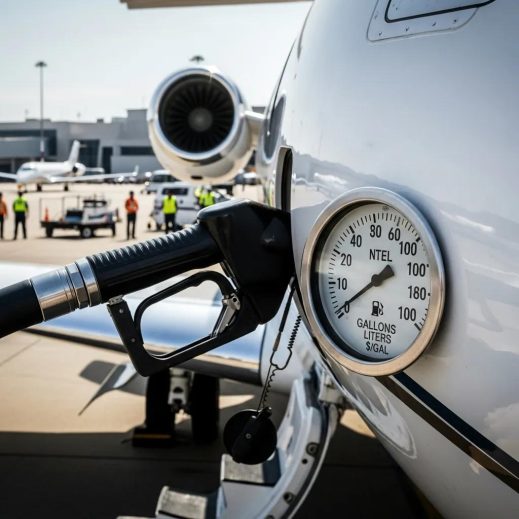
Jet A-1 fuel — the lifeblood of commercial aviation — has experienced sustained price volatility over the past two years. The causes are well documented: geopolitical instability disrupting supply chains, refinery capacity running below historic norms, and the escalating cost of carbon offsetting obligations being imposed on commercial carriers under expanding emissions trading schemes across the UK and Europe.
For a private operator like Charter-A, fuel cost changes are handled transparently — they are reflected directly in charter pricing, discussed openly with clients, and managed on a flight-by-flight basis. For a major commercial airline, the picture is far more complicated. They must absorb or redistribute rising costs across hundreds of routes, thousands of daily flights, and a passenger base that is acutely sensitive to ticket price increases.
The result is a set of pressures that are reshaping commercial aviation in ways that don’t make headlines — but that business travellers are beginning to feel on the ground:
Route rationalisation. Airlines are quietly cutting marginally profitable routes — particularly thinner European city-pair services — to concentrate capacity on high-yield trunk routes where fuel cost per passenger can be more easily absorbed. If your business takes you regularly to secondary European cities, you may already have noticed your options narrowing.
Reduced schedule frequency. On routes that remain, some carriers are reducing the number of daily departures. For the business traveller whose schedule depends on morning departure and same-day return flexibility, this matters enormously.
Fleet transition gaps. Rising fuel costs are accelerating decisions to retire older, less efficient aircraft — but replacement programmes take time. In the interim, capacity gaps are emerging, manifesting as reduced availability, higher load factors, and less scheduling flexibility in premium cabins.
Premium cabin price pressure. As fuel costs rise and margins compress, airlines are pushing harder on business- and first-class pricing. The value proposition of commercial business class on a one-hour European sector is becoming increasingly difficult to justify.
None of these changes is catastrophic in isolation. Together, they are creating a commercial aviation environment that is becoming progressively less predictable, less flexible, and frankly less suited to the demands of senior executives who need to be somewhere specific, at a specific time, ready to perform.
The Hidden Cost of the Commercial Airport
Even setting aside the fuel crisis and its downstream effects, there is a calculation that more and more of our clients are making for the first time — and once they make it, they rarely go back to commercial travel.
It goes like this.
A business class flight from London Heathrow to Geneva departs at 09:00. To be comfortable, you need to be at the airport by 07:00, which means leaving central London by 06:00 to allow for traffic. You land in Geneva at approximately 11:30 local time, collect your bags, clear any formalities, and are in a taxi by noon. You arrive at your meeting at 12:30, having been travelling since before six in the morning.
Now consider the alternative.
Your chauffeur collects you from your Mayfair office at 08:00. You are at Battersea Heliport by 08:15. Your helicopter departs at 08:30 and lands at Farnborough at 08:42. Your private jet departs Farnborough at 09:15. You land at Geneva’s private terminal at 10:35 local time, where a car is waiting on the apron. You are at your meeting by 11:15 — over an hour earlier — having left over two hours later, with no queues, no security theatre, no crowded lounges, and no baggage carousel.
That is not a marginal improvement. That is a fundamentally different travel experience — and increasingly, it is one that makes hard financial sense.
Who Is Making The Switch?
This is perhaps the most interesting part of the story, because the profile of the private aviation client is changing.
Private jet and helicopter travel was once the near-exclusive preserve of the ultra-wealthy — a luxury purchase made on the basis of comfort and status. That client still exists, and we serve them well. But the current wave of growth is being driven by a different profile entirely.
We are seeing scale-up founders whose time has become genuinely scarce and genuinely valuable. We are seeing corporate travel managers at mid-sized professional services firms who are crunching the numbers and finding that private aviation stacks up well. We are seeing senior partners at law firms, investment banks, and consultancies whose billable-hour rates make two hours at Heathrow Terminal 5 an actively poor use of company resources.
These are pragmatic, analytical people making pragmatic, analytical decisions. They are not buying a lifestyle — they are buying productivity, reliability, and control. And increasingly, the commercial aviation industry is making it easier and easier to justify that purchase.
The Wellness Argument Is Gaining Serious Traction
There is one more factor worth addressing, because it is beginning to appear in boardroom-level travel policy conversations in a way it simply wasn’t five years ago.
How does an executive arrive?
An executive who has navigated a major hub airport at peak hour — queued, jostled, delayed, and deposited into a crowded cabin for an hour — arrives at their destination in a measurably different state than one who has taken a helicopter from central London, boarded a quiet private jet, and landed directly at a private terminal where a car was waiting.
The first executive needs time to decompress and refocus. The second executive is ready to work the moment they land.
Corporate travel managers and HR directors are increasingly treating arrival conditions as a performance variable — not a perk. As the business case for employee wellbeing continues to strengthen across the professional services sector, private aviation is benefiting from a narrative shift that positions it not as an extravagance, but as a performance tool.
What The Helicopter-to-Jet Transfer Actually Looks Like
For those considering this service for the first time, here is exactly what the Charter-A integrated transfer experience involves.
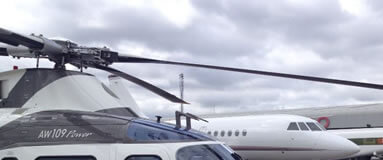
You are collected by a chauffeur from your London address — home, office, or hotel — and driven to Battersea Heliport on the south bank of the Thames, minutes from Chelsea, Knightsbridge, and Mayfair. The heliport is London’s only CAA-licensed central heliport, and our fleet — which includes the Airbus H145 D3, the Agusta 109 Grand, and the Eurocopter AS355 Twin Squirrel — operates exclusively with twin-engine aircraft, the highest safety standard available in commercial helicopter operations.
The flight to your departure airport takes minutes. At Farnborough, for example, the helicopter flight time from Battersea is approximately 12 minutes. You are met airside, transferred directly to your private jet, and the aircraft departs on your schedule — not an airline’s.
The entire experience, from your London address to wheels-up on your private jet, routinely takes under 45 minutes.
Popular routes our clients use this service for include:
- London to Geneva — 1 hour 20 minutes by private jet
- London to Paris Le Bourget — 45 minutes
- London to Nice and the Côte d’Azur — 2 hours
- London to Zurich — 1 hour 35 minutes
- London to Dubai — 7 hours
- London to New York — approximately 8 hours
A Final Thought
The 25% growth we have seen in demand for our helicopter-to-jet transfer service is not, we believe, a temporary spike. It reflects structural changes in commercial aviation that are gathering momentum, combined with a fundamental reassessment — particularly among senior professionals — of what travel time actually costs and what it is actually worth.
Commercial aviation will always serve the majority of travellers, and it will continue to do so. But for a growing cohort of executives for whom time, reliability, and performance are not negotiable, the calculus is shifting — and it is shifting in one direction.
If you would like to explore what an integrated private aviation solution could look like for your business or personal travel, our team is available around the clock.
Call us on +44 (0)20 7781 8094, or visit us at Charter-A.com and batterseahelicopter.com
We look forward to welcoming you on board.
