
Flight Time from London Battersea to Cheltenham Races by Helicopter: Your Complete Guide to Duration, Cost, and Booking
Helicopter transfers from London Battersea Heliport to Cheltenham Racecourse dramatically reduce travel time and deliver a VIP arrival tailored for race-day schedules. This guide explains typical flight durations, compares door-to-door times with road and rail, and outlines the main cost drivers and booking steps for Cheltenham Festival transfers. Readers will find aircraft recommendations, sample price frameworks, landing logistics at Cheltenham, and 2025 sustainability options that matter for high-profile events like the Gold Cup. The article also covers practical booking timelines, what to expect in quotes, and the ground services that complete a premium transfer. By the end you will understand how much time you save, what influences price, which helicopter types suit your party, and how to request a tailored quote or start a booking for a private helicopter, air taxi, or private jet transfer. Keywords woven through the guide include cheltenham helicopter, london to cheltenham, helicopter charter, and Battersea Heliport to Cheltenham Racecourse flight duration to help you find the right transfer option for race day.
How Long Is the Helicopter Flight from London Battersea to Cheltenham?
The Battersea Heliport to Cheltenham Racecourse helicopter route typically takes about 40–50 minutes of airborne time on a direct transfer, delivering a fast, reliable journey compared with congested roads. This duration reflects direct routing over the Thames Valley and Cotswolds, cruise speeds of common light-to-medium helicopters, and efficient point-to-point operations that avoid typical ground delays. The main benefit is consistent, predictable travel windows that let you plan arrivals and departures around race schedules with confidence. Understanding the variables that affect airborne time helps you select the right aircraft and plan realistic door-to-door windows for the Cheltenham Festival.
Flying time depends on distance, aircraft cruise speed, airspace routing and weather: stronger headwinds, restricted airspace or required routing can add minutes, while a favorable tailwind or a faster twin-engine helicopter reduces airborne time. Ground handling at Battersea and Cheltenham, including pre-flight briefings and disembarkation procedures, typically adds predictable minutes to door-to-door travel but still usually results in a major net saving versus driving. Below is a concise comparison of typical door-to-door travel estimates to illustrate time savings when booking a cheltenham helicopter transfer.
The door-to-door comparison highlights how helicopter transfers shrink variability on event days and free up more time for hospitality and racing, which is especially valuable during peak Cheltenham Festival congestion.
- Typical airborne time: 40–50 minutes.
- Typical door-to-door by helicopter (including ground transfers and handling): 90–120 minutes.
- Typical driving time in festival traffic: 3–4+ hours depending on congestion.
- Typical rail + transfer time: 2.5–3.5 hours including station transfers.
What Is the Typical Flight Duration Between Battersea Heliport and Cheltenham Racecourse?
Typical airborne duration for a direct Battersea-to-Cheltenham helicopter transfer is approximately 40–50 minutes, calculated from published cruising speeds and straight-line routing between the two points. This estimate assumes a standard light-to-medium helicopter cruising between 120–150 knots and minimal vectoring by air traffic control, which is common on direct event transfers. Variables that commonly affect this estimate include weather (wind and visibility), temporary airspace restrictions and the specific aircraft type used; heavier or slower models may add five to ten minutes. Planning with a conservative margin ensures you account for pre-flight checks and any unforeseen minor delays, which maintains the reliability that private helicopter travel is chosen for.
How Does Helicopter Travel Compare to Road Travel Time for Cheltenham Races?

Helicopter travel reduces both average travel time and variability compared with driving or rail during the Cheltenham Festival, where local roads often experience severe congestion and parking delays. A helicopter transfer typically compresses the journey into a predictable 90–120 minute door-to-door window versus common 3–4+ hour driving times on race days, saving hours and avoiding stress associated with road queues. The reliability advantage also means fewer contingency plans and more flexibility for arrivals and departures around race programming. For groups or VIP travellers, that consistency and the ability to stage arrivals close to hospitality areas are often decisive benefits.
- Time certainty: Helicopters offer predictable arrival windows, minimizing delays.
- Reduced ground time: Less waiting in traffic and quicker post-flight transfers.
- VIP arrival: Direct access to event transfer points close to hospitality areas.
The comparison shows that while rail can be a good alternative for single travellers, private helicopter charter often delivers superior time savings, particularly for groups and tight schedules.
For travellers who value precise timing and minimal disruption on Cheltenham Festival days, private air charters provide the quoted flight durations and consistent time savings; availability varies so requesting a tailored quote early helps lock in a preferred aircraft and departure window.
What Is the Cost of Helicopter Charter for the Cheltenham Festival?
Helicopter charter pricing for Cheltenham Festival transfers varies by aircraft type, occupancy, positioning requirements and event-season surcharges, but typical one-way cost ranges can be described in tiers to set expectations. Costs reflect the hourly rate of the helicopter, crew costs, landing and handling fees at both Battersea and Cheltenham, ground transfers and any waiting time or overnight repositioning that might be required. Understanding what a quote usually includes and which elements are optional helps you compare offers and avoid surprises. Below is an EAV-style pricing table to provide quick comparative context for typical aircraft classes used on this route.
This sample pricing demonstrates how capacity and aircraft class drive costs; exact quotes will reflect positioning legs, peak-event surcharges and included services, so treat these figures as indicative and request a tailored quote for precise pricing.
Which Factors Influence the Price of a Helicopter Transfer from London to Cheltenham?
Several clear cost drivers determine a Cheltenham helicopter quote: aircraft type and hourly rate, positioning or empty-leg requirements, landing and handling fees, passenger count, and event-season demand surcharges. Aircraft hourly rates differ markedly between light single-engine helicopters and comfortable twin-engine VIP models, and operators add repositioning fees if the aircraft must fly from another base to Battersea. Festival dates often carry peak demand pricing and potential minimum booking durations or waiting-time charges; similarly, night or late departures may require twin-engine aircraft that meet regulatory requirements, which increases the rate. Ground services such as chauffeur transfers, meet-and-greet and expedited handling also contribute to the final price, so clarity in the quote about included items is essential.
- Aircraft type and hourly operating cost.
- Positioning legs (empty repositioning flights).
- Landing, handling and heliport fees at both ends.
- Peak-event surcharges, waiting time and ground services.
Summarizing, the most controllable elements are aircraft selection and included ground transfers, while positioning and event surcharges are external factors for which early booking and flexible timing can reduce impact.
What Are Typical Pricing Examples for Helicopter Charter to Cheltenham Festival?
To illustrate, here are three concise sample scenarios that clarify how assumptions change price: a solo one-way light single transfer, a small VIP group return with a light twin, and a larger group return in a medium twin. These examples assume direct routing, standard ground transfers and no extraordinary positioning legs; real quotes may differ based on exact pickup times and heliport availability. The sample table below presents indicative price points and the assumptions behind each scenario to help you estimate budgets before requesting a bespoke quote.
These examples are illustrative; a formal quote typically lists aircraft, crew, included landing/handling fees and ground transfers, and clarifies optional extras. For accurate pricing, request a tailored quote that specifies passengers, luggage, desired arrival/departure windows and any hospitality requirements.
For users ready to move from planning to booking, quotes normally itemize aircraft, crew, landing fees and standard transfers; requesting a tailored quote early in your planning secures aircraft availability and locks in timing for Cheltenham Festival travel.
How Do You Book a Private Helicopter from London Battersea to Cheltenham Races?
Booking a private helicopter transfer involves a clear workflow: initial inquiry with trip details, receipt of a tailored quote, confirmation with deposit or payment, coordination of passenger information and documentation, and on-the-day handling instructions. The process is designed to ensure regulatory compliance, crew briefing and ground handling align with your arrival and departure windows for the festival. Recommended lead times increase during Cheltenham Festival peak days, so allowing several weeks or months for preferred slots helps secure suitable aircraft and ground services. Below is a precise step-by-step procedure to guide a typical booking.
- Inquiry: Provide pickup and return dates/times, passenger count, luggage, and any chauffeur or hospitality needs.
- Quote & Availability: Receive a tailored quote that lists aircraft, inclusions, positioning fees and any event surcharges.
- Confirmation: Confirm the booking with required deposit or payment terms and supply passenger names and ID details.
- Pre-flight Coordination: Receive final flight plan, ground transfer timelines, and baggage allowances prior to travel.
- Day-of Execution: Arrive at Battersea as instructed for check-in, complete security briefings and board for the scheduled transfer.
What Is the Step-by-Step Process for Booking Your Cheltenham Helicopter Transfer?
When you request a booking, the operator typically asks for trip details and then provides a quote that itemizes the aircraft, crew, landing fees, estimated flight time and any ground transfer services; review these details carefully. After acceptance, a deposit or payment secures the aircraft and the operator collects passenger names, ID required for flight manifests and any special handling requests such as extended waiting time or hospitality. The operator will confirm a final itinerary and coordinate with Cheltenham Racecourse handling for landing permissions and passenger transfers to ensure a seamless arrival. On the day, follow the provided arrival window and staff instructions for check-in and boarding; the operator then completes the flight and hands passengers to pre-arranged ground transport or hospitality teams.
What Are the Key Considerations When Booking for the Cheltenham Gold Cup?
Booking for the Gold Cup demands earlier lead time, flexibility on arrival/departure windows and clear contingency planning because demand and local access restrictions peak during major race days. Expect higher demand and potential minimum booking durations; confirm whether your preferred aircraft is subject to repositioning and whether that adds cost or timing constraints. Coordinate ground transfers and hospitality windows carefully to align helicopter arrivals with race entry times and VIP schedules, and verify luggage allowances if race-day attire requires extra space. Finally, confirm cancellation and amendment terms in case event timing changes and consider arranging brief buffer windows around scheduled flights to accommodate small timing variances.
Planning early and confirming precise ground-handling details reduces risk; importantly, request a detailed quote that lists inclusions and optional extras so you can make informed comparisons and secure an optimal transfer package.
Within the booking process, explicitly request a tailored quote to confirm aircraft availability, exact inclusions (aircraft, crew, landing fees and transfers) and payment terms so you can proceed to secure your Cheltenham transfer with confidence.
Which Helicopter Models Are Best for the London to Cheltenham Flight?
Selecting the right helicopter for Battersea to Cheltenham depends on passenger count, luggage, comfort expectations and whether late departures or instrument flight rules (IFR) could apply. For small parties, light singles like the AS350/H125 provide efficient one-way transfers; for VIP groups, light twins such as the Agusta 109 balance speed and cabin comfort; medium twins suit larger groups or when extra luggage and space are priorities. Twin-engine helicopters offer operational flexibility and are often recommended for late departures or where regulatory redundancy is required, while single-engine types are economical for short daytime hops. Below is an EAV-style technical comparison of common models typically used for Cheltenham transfers.
What Are the Features of Popular Helicopters Used for Cheltenham Transfers?
Popular helicopters for Cheltenham transfers emphasize a mix of speed, cabin comfort, luggage capacity and low-vibration ride quality to suit race-day attire and hospitality needs. Light singles are prized for efficiency and lower operating cost, offering acceptable cabin space for short hops and flexible scheduling. Light twins provide extra cabin width, faster cruise speeds and redundancy that enhances safety margins and allows more comfortable baggage storage for formal wear. Medium twins offer greater space for groups and more sophisticated interiors and soundproofing, which benefit longer ground transfers and on-board hospitality arrangements.
Why Are Twin-Engine Helicopters Recommended for Late Departures to Cheltenham?
Twin-engine helicopters are recommended for late departures because regulatory frameworks and operational safety considerations often require engine redundancy for flights conducted at night or under instrument meteorological conditions. The redundancy of twin engines allows operators to maintain flight safety margins if an engine failure occurs, and it usually permits more flexible routing in marginal weather. For Cheltenham Festival itineraries that may include evening returns or variable departure windows, a twin-engine option increases the likelihood of on-time completion without switching to alternative arrangements. Operationally, twin-engine helicopters also frequently carry enhanced avionics for better navigation and passenger comfort in less predictable conditions.
Choosing a twin-engine aircraft when planning late departures reduces the chance of cancellations or forced diversions and supports a higher reliability standard for event transfers.
What VIP Services and Landing Facilities Are Available at Cheltenham Racecourse?
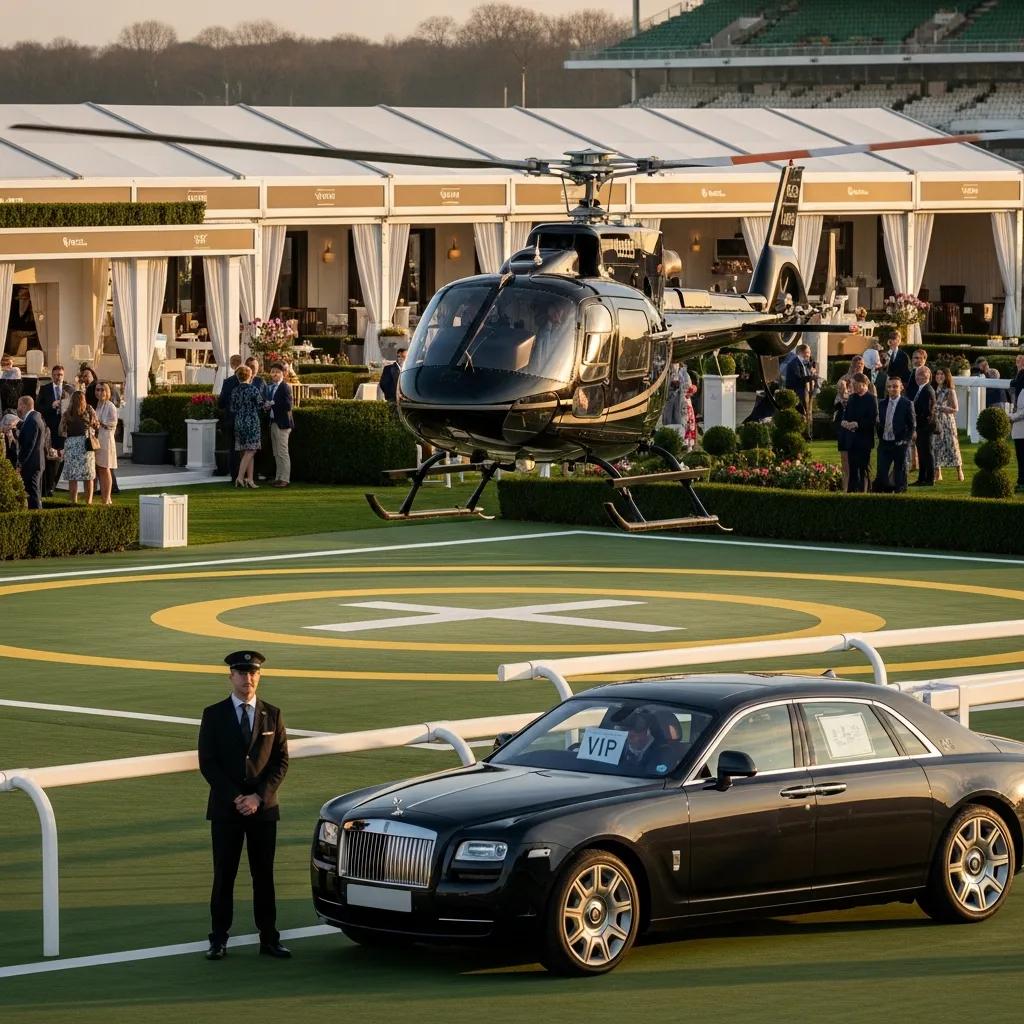
Cheltenham Racecourse and experienced air charter operators coordinate to provide defined landing areas, ground handling and seamless transfers between helipads and hospitality zones during the Festival. Typical services offered in quotes include meet-and-greet, baggage handling, chauffeur handoffs, and coordination with racecourse security to expedite passenger transfer from the landing area to VIP enclosures. Landing logistics vary by event day and local permissions; operators secure necessary clearances and arrange handlers to escort passengers promptly. The table below outlines common VIP services, whether they are usually included or optional, and notes typical provider arrangements to clarify expectations in a quote.
Understanding which services are included in a charter quote prevents last-minute surprises and ensures a cohesive VIP arrival experience from Battersea through to event hospitality.
Where Do Helicopters Land at Cheltenham Racecourse During the Festival?
During the Cheltenham Festival, helicopters land at designated helipad areas or temporary landing zones arranged by the racecourse and local authorities to manage safety and passenger flow. These landing sites are positioned to facilitate rapid transfer to hospitality zones, but exact distances and transfer times depend on event-day layouts and spectator area restrictions. Operators coordinate permits and handoff procedures with racecourse management and ground handlers to provide clear instructions for arrivals, including designated meet points and short chauffeur transfer durations. During peak festival days, staging and queuing protocols may apply, so advance coordination and confirmed arrival times are essential for smooth transfers.
What Luxury and Chauffeur Services Are Included in the Cheltenham Helicopter Experience?
Standard luxury services often included in a Cheltenham helicopter transfer quote comprise meet-and-greet at the helipad, dedicated baggage handling, and chauffeur-driven transfers to and from hospitality suites; premium packages may add dedicated hospitality hosts or bespoke catering. Optional upgrades can include enhanced chauffeur vehicle classes, extended waiting time, VIP escorts through secured racecourse entrances or tailored on-site hospitality coordination. It is important to confirm in the quote which services are included and which are optional, along with any associated fees, to align expectations and ensure a premium experience on arrival. Explicitly listing these items in a booking confirmation prevents misunderstanding and supports a polished, seamless guest experience.
How Is Sustainable Private Helicopter Travel Shaping Cheltenham Event Transfers in 2025?
Sustainability in private helicopter transfers is increasingly important in 2025, with operators offering measures such as carbon offsetting, the use of more efficient modern rotorcraft and limited adoption of sustainable aviation fuel (SAF) blends where compatible with turbine engines. While fully electric rotorcraft remain early-stage for longer-range event transfers, improvements in engine efficiency and operational practices meaningfully reduce emissions per passenger compared with older fleets. Carbon offset programs are commonly offered as add-ons in charter quotes, and some providers include offsetting as part of premium packages to appeal to eco-conscious clients. Considering sustainability options during booking informs both environmental impact and potential cost differentials.
What Eco-Friendly Helicopter Options Are Available for Cheltenham Transfers?
Practical eco-options in 2025 include booking newer, more fuel-efficient turbine helicopters, selecting shared or higher-occupancy transfers to lower per-passenger emissions, and requesting SAF where available for turbine-powered flights. Early-stage electric vertical take-off and landing (eVTOL) aircraft may offer future alternatives for short hops, but current payload and certification limits make them uncommon for Cheltenham transfers at scale. For most event transfers, the most realistic sustainability actions are choosing efficient aircraft, consolidating group transfers and including verified carbon offsets in the quote. Operators can itemize these options in a booking proposal to show emissions impact and associated costs.
How Does Carbon Offsetting Enhance Sustainable Private Aviation for Events?
Carbon offsetting allows passengers to compensate for emissions by funding verified environmental projects, and in private aviation offsets are typically calculated per flight based on fuel burn and passenger count, then presented as an optional line item in a charter quote. Offset programs vary in price and verification standards, so selecting recognized offset schemes and requesting transparent reporting in the quote ensures credibility. Including offsetting in your booking demonstrates a commitment to sustainability without materially changing operational logistics, though it may add a modest cost that should be disclosed upfront. For Cheltenham Festival transfers, combining efficient aircraft selection with offset purchases provides a practical route to reduce net environmental impact.
Integrating sustainability into charter planning requires operators to itemize available options in the quote and explain trade-offs; asking for these specifics during the booking step ensures transparent decision-making.
For personalised assistance with timing, cost breakdowns, aircraft selection, VIP handling and sustainability options, request a tailored quote or start a booking that specifies your passenger count, luggage and preferred arrival/departure windows for Cheltenham Festival transfers — this will secure availability and clarify exact inclusions for private helicopter, air taxi or private jet travel.
